When evaluating digital marketing strategies, businesses frequently compare the Cost Per Lead (CPL) of inbound, organic methods like content marketing against paid acquisition channels such as Google Ads (Pay-Per-Click or PPC).
Key Takeaways
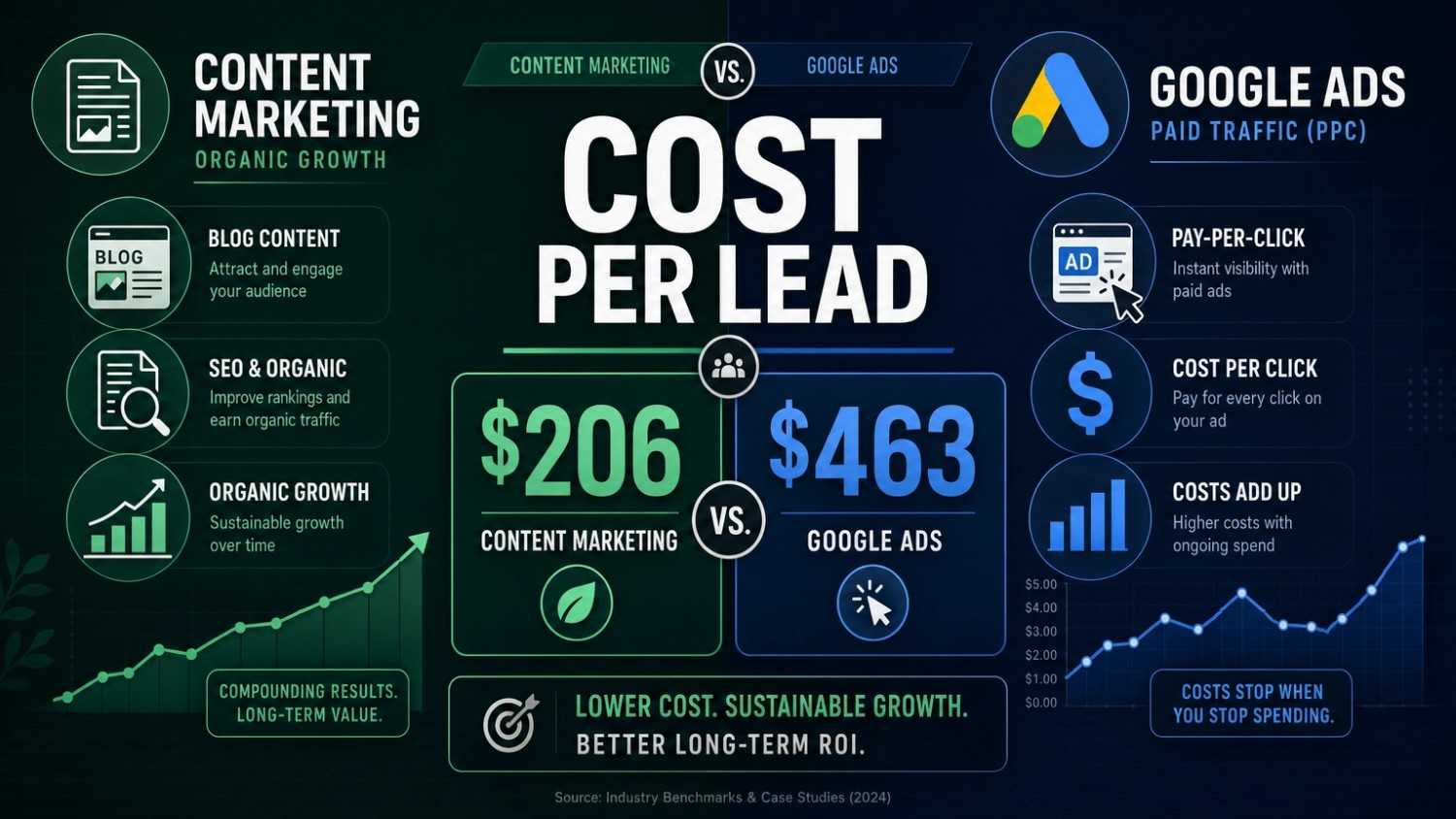
- Organic beats paid on cost — Content marketing averages $206 CPL vs. Google Ads’ $463 CPL, making paid leads more than twice as expensive.
- Google Ads costs are rising — The average CPL increased 5.13% in 2025, driven by AI Overviews, smarter bidding algorithms, and greater competition pushing CPC to $5.26.
- Industry matters — The cost gap is widest in complex B2B sectors (SaaS, Engineering) and narrows in commoditized markets like eCommerce and Cybersecurity.
- Content marketing compounds over time — It costs 62% less per lead than outbound marketing and generates 3x as many leads, but requires patience to build momentum.
- Organic leads are higher quality — People who find you through search have actively sought a solution, meaning stronger intent and better downstream ROI.
- Neither channel alone is ideal — Experts recommend a blended strategy: organic as the primary lead engine, with paid ads used tactically for specific high-value keywords or short-term pushes.
- 91% of B2B marketers use content marketing — And 74% find it effective, making it the dominant and proven channel for B2B lead generation.
Recent data from 2025 and 2026 highlights a consistent trend: while Google Ads can deliver immediate visibility and high-intent leads, organic marketing generally yield a significantly lower CPL over time.
Overall Cost Per Lead Benchmarks
Industry benchmarks reveal a stark contrast between organic and paid channels. According to comprehensive B2B data, the average cost per lead across all paid channels is $310, whereas organic leads cost significantly less at $164. When blending both strategies, the average B2B cost per lead settles around $237.
When breaking down these costs by specific marketing channels, the disparity between organic search and paid search becomes even clearer. Data from Sopro’s 2025 benchmark report indicates that the average CPL for SEO and organic content is $206, with costs ranging from as low as $14 to a high of $397.
HubSpot’s 2025 research further supports this channel-specific cost difference. Their data shows that top-of-funnel leads generated through Google Ads cost between $100 and $175, climbing to $300–$750 for bottom-of-funnel, conversion-oriented campaigns.
In contrast, PPC campaigns, primarily driven by Google Ads, carry an average CPL of $463, ranging from $175 to $751. This makes the average Google Ads lead more than twice as expensive as an organic lead.
Meanwhile, content syndication and organic efforts typically sit in a lower range, with top-of-funnel CPLs around $65–$95 and bottom-of-funnel CPLs between $200 and $400.
Industry-Specific Comparisons
The cost difference between organic content marketing and paid search varies significantly depending on the industry. First Page Sage’s 2026 report analyzed CPL across 30 different sectors, demonstrating that organic channels consistently outperform paid channels in cost efficiency.
| Industry | Average Organic CPL | Average Paid CPL (Google Ads/PPC) | Difference |
| B2B SaaS | $164 | $310 | Paid is 89% higher |
| Financial Services | $555 | $761 | Paid is 37% higher |
| Healthcare | $320 | $401 | Paid is 25% higher |
| Engineering | $201 | $371 | Paid is 84% higher |
| Construction | $174 | $280 | Paid is 60% higher |
| Legal Services | $516 | $784 | Paid is 51% higher |
| Real Estate | $416 | $480 | Paid is 15% higher |
| eCommerce | $83 | $98 | Paid is 18% higher |
(Data sourced from First Page Sage’s 2026 Average Cost Per Lead by Industry Report.)
As the table illustrates, industries with complex, high-value sales cycles, such as B2B SaaS and Engineering, see massive cost savings when utilizing organic content marketing compared to paid search. In the Engineering sector, for example, the paid CPL ($371) is nearly double the organic CPL ($201).
However, in highly competitive consumer-facing or commoditized markets like eCommerce, the gap narrows. The organic CPL for eCommerce is $83, while the paid CPL is $98, reflecting a highly saturated market across all acquisition channels. Similarly, in the Cybersecurity sector, organic and paid CPLs are almost identical ($404 vs. $411), suggesting that competition for visibility is fierce regardless of the medium.
Google Ads Trends and Rising Costs
The cost of acquiring leads through Google Ads has been steadily increasing. WordStream’s 2025 Google Ads Benchmarks report, which analyzed over 16,000 campaigns, found that the overall average CPL in Google Ads across all industries rose to $70.11, a 5.13% increase from the previous year.
Several factors are driving up the cost of Google Ads:
- Increased Competition and CPC: The average Cost Per Click (CPC) in Google Ads rose to $5.26 in 2025, with 87% of industries experiencing an increase in CPC.
- AI Overviews: The introduction of AI Overviews in search results is occupying top ad placements, leading to increased bidding activity and higher CPC rates to maintain visibility. As fewer users scroll down to traditional ad placements, click-through rates on key terms are declining.
- Smart Bidding: Campaigns utilizing automated smart bidding strategies have seen sharper increases in CPC, as Google’s machine learning algorithms bid higher for queries that are more likely to convert, even if they are more expensive.
The Value of Content Marketing
While content marketing and SEO require a longer lead time to produce results, they offer substantial long-term ROI and cost efficiency.
Content marketing is widely recognized as a highly effective lead generation strategy. According to industry statistics, 91% of B2B marketers use content marketing, and 74% find it effective for generating leads. Furthermore, content marketing costs 62% less than traditional outbound marketing on a per-lead basis, while generating three times as many leads.
The quality of leads generated through organic content is also a significant factor. Leads sourced from organic channels are often considered “lower-funnel” because they have actively searched for a solution and engaged with educational content, indicating higher intent. HubSpot’s research notes that SEO and thought leadership are among the marketing channels that result in the highest ROI and the highest quality of leads.
Conclusion
The statistics clearly show that organic-focused marketing provides a more cost-effective method for generating leads compared to Google Ads. While Google Ads offers immediate visibility and targets high-intent searchers, the rising costs per click and increasing competition make it an expensive channel, with an average CPL of $463 compared to $206.
For sustainable growth, marketing experts recommend a blended approach. Organic channels like content marketing should serve as the primary driver of new, cost-efficient leads, while paid channels like Google Ads can be leveraged strategically for short-term growth or to target highly specific, high-value commercial keywords.
Organic vs Google Ads
Lead Generation ROI Calculator
Enter your numbers to see the difference in ROI between content marketing and paid search — based on 2025–2026 industry benchmarks.
Total spend allocated to this channel per month.
Split budget evenly across both channels and see combined results.
CPL benchmarks sourced from Sopro 2025, First Page Sage 2026, HubSpot 2025, and WordStream 2025.
Results are illustrative estimates, not guarantees.
How leads are calculated
The organic and paid channels use different formulas:
Google Ads (Paid)
Straightforward — leads are consistent from day one:
Leads = (Monthly Budget ÷ Paid CPL) × Projection Period
So if you spend $5,000/month at $463 CPL over 12 months, you get roughly 130 leads.
Organic / Content Marketing
Organic uses a linear ramp-up model to reflect the reality that content takes time to gain traffic. Each month's leads are multiplied by a ramp factor:
Ramp factor = current month ÷ ramp-up months (capped at 1 once fully ramped)
So if your ramp-up period is 6 months:
- Month 1 → 1/6 = 17% of full lead volume
- Month 3 → 3/6 = 50%
- Month 6 → 6/6 = 100%
- Month 7+ → 100% (fully ramped, stays there)
Each month's contribution is (Monthly Budget ÷ Organic CPL) × ramp factor, and all months are summed for the total.